
Allan and the Ice-gods
Final Allan Quatermain novel involving past-life regression.

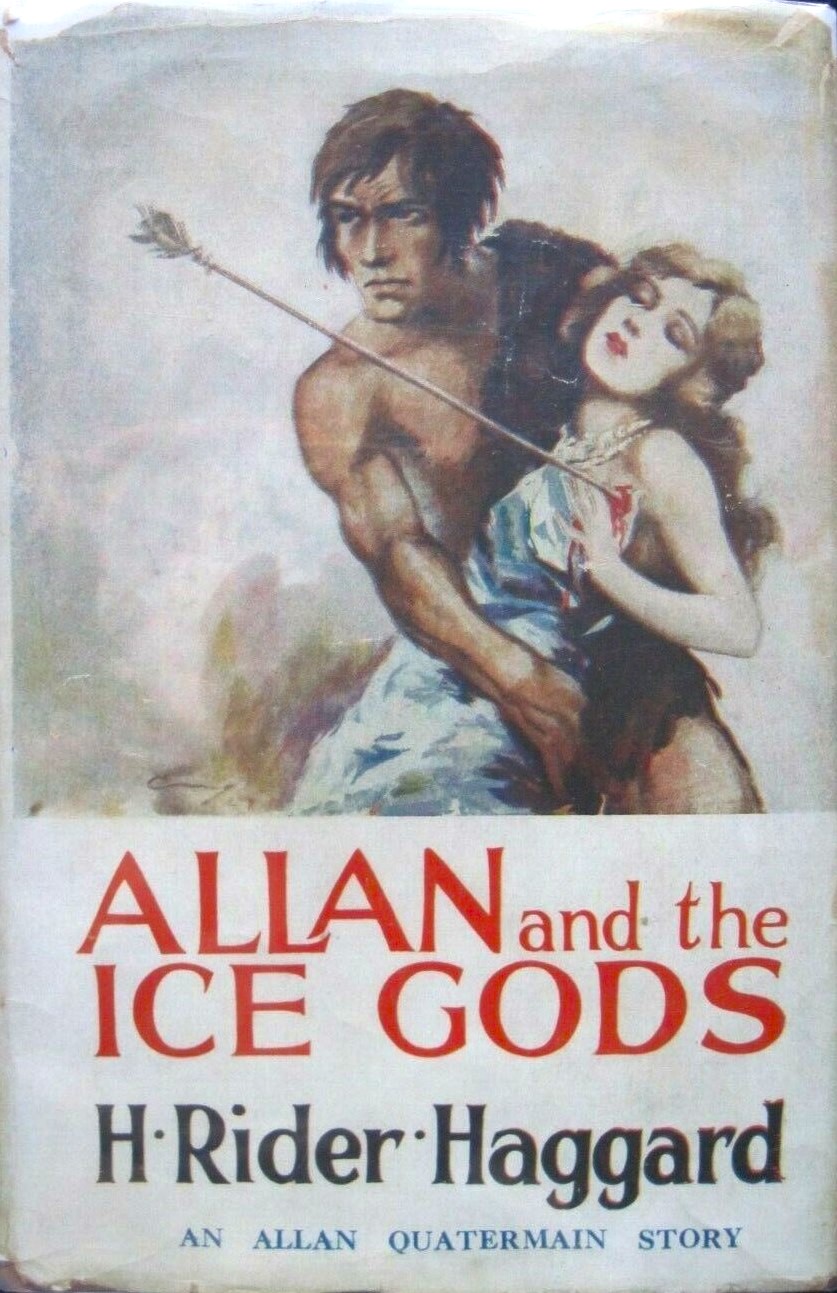
Cover artist unknown · Public domain
H. Rider Haggard’s *Allan and the Ice-Gods* closes out his series of eighteen Allan Quatermain novels and short stories, being the fourteenth Quatermain novel published. It also wraps up a trilogy—begun with *The Ivory Child* and continued in *The Ancient Allan*—that centers on the Taduki drug and the character Lady Luna Ragnall. The idea for the book came from Rudyard Kipling, who suggested it to Haggard. The story sends Quatermain into a past-life regression, where he lives as a Stone Age ancestor and faces various adventures. Scholars have noted the novel as a literary treatment of eugenics and evolutionary ideas.
After the awkwardness of their shared Taduki vision in *The Ancient Allan*—in which he and Lady Ragnall nearly married—Allan Quatermain turns down three of her invitations to try the drug again, vowing never to use it. Lady Ragnall tells him she has used it once more and learned that their ancient counterparts, Amada and Shabaka, were actually married. Allan reads in the paper that she has left for Egypt. About six weeks later, he experiences a psychic episode and learns that Lady Ragnall died of heart failure at that same moment, at her husband’s grave in the Temple of Isis. Allan inherits her estate, which Lord Ragnall’s next-of-kin, Mr. Atterby-Smith, had wanted. He gives most of it to charities but keeps a box of Taduki she left him. Tempted to break his vow, he resists until his friend Captain John Good visits. Good persuades him to use the drug, and the two enter a vision together.
In the vision, Allan becomes Wi, a civilized man in a barbaric Ice Age tribe. The tribe worships a man and a mammoth frozen in ice. Wi’s closest friend is Pag, an outcast who invents new technologies. Wi kills the corrupt chief Henga and reforms the tribe, instituting monogamy, decision by council, and new tools. Pag rises in power and stops a wolf attack. Wi and Pag travel to fight a saber-toothed tiger. Wi finds an unconscious young woman named Laleela in a canoe. He falls in love with her, as does his brother Moananga. Most of the tribe thinks Laleela is a witch, and Wi’s wife Aaka wants her dead. Pag urges Wi to marry Laleela to protect her, but Wi knows that would break his own monogamy rule.
A tribe of red-bearded warriors attacks and is defeated. Wi kills an aurochs. When he rejects the ice-gods in favor of Laleela’s faith, the tribe demands a sacrific
- author
- H. Rider Haggard
- series
- Allan Quatermain
- publication_order
- 14th and final Allan Quatermain novel
- trilogy
- Final in Taduki drug trilogy (with The Ivory Child and The Ancient Allan)
- inspiration
- Idea given to Haggard by Rudyard Kipling
- themes
- Eugenics and evolution in literature and culture
Lore & Background
The plot follows Allan Quatermain, who after a previous taduki-induced vision feels awkward toward Lady Luna Ragnall and vows never to use the drug again. Lady Ragnall informs him that their ancient counterparts were married, then travels to Egypt and dies of heart failure. Allan inherits her estate and a box of taduki, which he initially resolves not to use, but his friend Captain John Good persuades him to take the drug. They enter a vision where Allan awakens as Wi, a civilized man in the Ice Age, who challenges a corrupt chief, institutes reforms, and encounters a woman named Laleela. The story culminates in a glacier thaw and Wi's sacrifice, after which Allan and Good awaken and discuss their adventure.
Reader's Guide
Allan and the Ice-Gods is significant as the final entry in H. Rider Haggard's Allan Quatermain series, concluding the character's adventures and the Taduki drug trilogy. The novel has been noted for its treatment of eugenics and evolution, reflecting late-Victorian and Edwardian cultural concerns. Its influence extends to later writers: Philip José Farmer and Christopher Paul Carey used characters and plot elements from this novel in their Khokarsa series of prehistoric adventure novels, which Farmer described as an amalgamation of the works of Burroughs and Haggard. The novel also incorporates themes of ancestral memory and past-life regression, with Allan speculating that the taduki drug awakens ancestral memory rather than actual past lives. The work received a two-star rating from David Pringle.
Did You Know?
- The novel was based on an idea given to Haggard by Rudyard Kipling.
- Allan and the Ice-Gods is the final novel in a trilogy involving the Taduki drug and Lady Luna Ragnall.
- The story features a character named Pag, an outcast who creates many new technologies.
- Philip José Farmer and Christopher Paul Carey used elements from this novel in their Khokarsa series.
Gallery
Frequently Asked Questions
What is Allan and the Ice-Gods about?
H. Rider Haggard's novel sends Allan Quatermain on a past-life regression in which he relives the existence of a Stone Age ancestor. The protagonist navigates a series of prehistoric adventures while confronting the enigmatic Ice-gods of that ancient world.
Where does Allan and the Ice-Gods fit in the Quatermain series?
It is the fourteenth and final Allan Quatermain novel Haggard published, bringing his entire cycle of eighteen Quatermain stories to a close. It also caps off a three-book arc built around the Taduki drug and Lady Luna Ragnall, following The Ivory Child and The Ancient Allan.
Who suggested the idea for Allan and the Ice-Gods?
Rudyard Kipling pitched the past-life regression concept to H. Rider Haggard, who then expanded it into a full-length Quatermain adventure. The novel is thus a direct product of Kipling's creative suggestion to his fellow author.
What are the major themes in Allan and the Ice-Gods?
Scholars have identified the novel as a literary treatment of eugenics and evolutionary theory, using the ancestral-regression framework to interrogate ideas about human development and racial heritage. The Stone Age setting allows Haggard to dramatize questions of biological progress and cultural inheritance.
Is there a sequel to Allan and the Ice-Gods?
No. As both the last published Quatermain novel and the final installment of the Taduki drug trilogy, it stands as the definitive endpoint of Haggard's Allan Quatermain canon. No further Quatermain stories followed within the original series.
More in British fantasy novels 1-24
Spotted an error? Know more?
This is a living reference — every entry is fact-audited, and reader corrections feed straight into our audit queue. Suggest an edit · See this site's audit record